



















Zero Waste: Producer Responsibility
What is Producer Responsibility
Extended Producer Responsibility (EPR) is a fundamental principle of Zero Waste. Also known as Product Stewardship, EPR is a strategy that places a shared responsibility for end-of-life management of consumer products on the manufacturers of the products, while encouraging product design that minimizes negative impacts on human health and the environment at every stage of the product's lifecycle.
EPR has been increasing applied as a policy approach throughout Europe and Canada since the early 1990s. Over the past five years, the U.S. has adopted the principles of EPR largely through state-level action; nearly half of U.S. states now require product stewardship for outdated electronic equipment. EPR can be applied to many products that are toxic or costly to manage; most commonly electronics, packaging, carpet, and household hazardous wastes such as paint, batteries, pesticides, and fluorescent lighting.
EPR basically extends the polluter pays principle to the majority of the waste stream, specifically products and packaging. If you manufacture or consume a product, you should be fully responsible for the pollution it causes as well as the costs of dealing with it when the consumer is done using it. Right now, the financial burden and infrastructure needed—be it landfills, curbside recycling or hazardous waste collections—fall upon local governments. Yet these local governments cannot control who buys or makes what products and are faced with ever-increasing expenses to manage these materials. EPR restores fairness to the system so all taxpayers are not left footing the bill for the actions of some—manufacturers and consumers cover the full costs of their actions.
Examples of EPR
Container deposits, or bottle bills, are one of the earliest forms of producer responsibility.
Consumers are charged a small fee when they purchase a beverage and the fee is refunded when the container is returned. Manufacturers of beverage containers partner with retail stores and other locations to recycle the containers. According to the Container Recycling Institute, states with bottle bills recycled an average of 76% of their carbonated beverage containers while states without deposit laws recycled only 37% of these containers (2006). Learn more about bottle bills and container recycling.
Taking back obsolete electronics
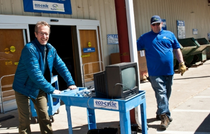
Dell became the first electronics manufacturer to take back its products from consumers free of charge for recycling in 2006. In 2009, Dell expanded its policy to ban exporting hazardous materials overseas. Campaign pressures from several groups, as well as European policy requiring manufacturers to take back waste electronics for recycling, led to the policy adoption. Dell is now a global leader in EPR for its electronics. Learn more about Dell’s electronics recycling. Learn more about electronics recycling including what regulations states have passed and which manufacturers are taking responsibility for their toxic products.
Proper handling of toxic products
British Columbia required paint manufacturers to set up and fund a system to take back their waste paint back in 1994. In 1997, the province passed groundbreaking regulation requiring manufacturers to create EPR programs for several products, including flammable liquids, pesticides, pharmaceuticals, oil and gasoline. The province continues to add new materials to the regulation, such as tires and electronics, and similar regulations are expanding throughout Canada. Under most of these systems, when consumers purchase one of these designated products, they typically pay a small eco-fee at the point of sale. These fees fund the collection and processing of these products when they are discarded so consumers can recycle them free of charge. In 2009, Canada announced a nationwide action plan for Extended Producer Responsibility. Learn more about British Columbia’s EPR programs.
Learn More and Get Involved
State Action
Eco-Cycle is a proud member of the Colorado Product Stewardship Council, working to bring producer responsibility to Colorado. Follow our activities and join in the discussions by checking out the CoPSC website.
Additionally, many states have now formed product stewardship councils. Find one near you.
National Action
There are two main groups dedicated to advancing EPR in the U.S.:
Visit their websites to:
- Track producer responsibility legislation across the country
- Download “Framework Principles for Product Stewardship Policy”
- Learn what’s happening with product stewardship for specific priority products such as paint and pharmaceuticals
- Start a state product stewardship council
- Attend webinars and conference calls to advance producer responsibility
- And much more…


