
















Dear Nan,
Well the answer is yes if where you live people drive on the left side of the road, play football with their feet and enjoy their French fries dipped in mayonnaise. However, if your people pass on the left, play football with hands and helmets and prefer their freedom fries dipped in ketchup, the answer is no. Unlike their counterparts in places like the European Union, federal legislators in the U.S. are less inclined to pass laws to make producers take their products back or to hold them accountable for the environmental impacts of their products and packaging.
But in the absence of federal leadership in this country, local communities are moving ahead to create our own stars and stripes version of what is globally referred to as Extended Producer Responsibility (EPR), an essential part of a Zero Waste system. EPR holds producers, manufacturers, importers and retailers responsible for the entire life-cycle of their product and packaging- from design to production to discard. Four U.S. states have passed legislation to establish more convenient electronics recycling, with varying degrees of financial involvement from manufacturers.
Some international companies like Hewlett Packard and Dell are now voluntarily (after some strong encouragement from consumers) taking their products back for recycling, and Dell recently announced it will offer this service free of charge for any Dell product.
Here at home, we at Eco-Cycle are working to create a successful model for the U.S. where manufacturers and retailers voluntarily partner with recycling programs like ours to establish or support a recycling opportunity for their product or packaging. We call our new program Partners for Responsible Recycling (PRR) and so far we have three partners.
|
Look for this decal on the doors of retailers and manufacters taking responsibility for the products and packaging they produce or distribute. |
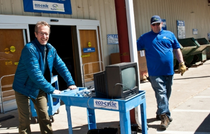
Recognizing electronics are a significant and toxic part of our community's waste stream, ListenUp, a local retailer of high-quality home entertainment systems, became a PRR. Listen Up financially supports the Center for Hard-to-Recycle Materials (CHaRM) electronics recycling program and also gives customers a coupon to recycle an electronic product at the CHaRM.
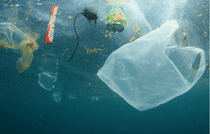
EPR isn't just about electronics, it's about any product that is difficult to recycle. Taking responsibility as the largest local generator of plastic newspaper sleeves, a previously non-recyclable material, the Daily Camera partnered with Eco-Cycle to financially support the creation of a plastic bag recycling program at the CHaRM.
Our newest Partner, CompUSA in Boulder, has set a new environmental standard for retailers nationwide by working with Eco-Cycle to create a convenient in-store recycling opportunity for its customers. The innovative "Buy One, Recycle One on CompUSA" program allows customers who purchase a new electronic item at the Boulder CompUSA store to bring in the equivalent old piece of equipment to have it recycled, and CompUSA covers the cost to recycle it through Eco-Cycle.
CompUSA extended its partnership by financially supporting our white block foam (a.k.a. "Styrofoam") recycling program at the CHaRM since many of their products come packaged in block foam. Sales Manager Nick McCormick tells us, "It's an eye-opener for people. They are amazed that we're doing this. Now we are getting people who say they will shop with us rather than a competitor because of it."
The PRR program is in its infancy and we are looking to partner with other local producers or retailers to support recycling for these and other "hard-to-recycle" products accepted at the CHaRM such as cell phones, textiles, books, shoes, and printer cartridges. With these efforts, maybe someday soon we'll have producer responsibility akin to the kind enjoyed in the E.U. But mayonnaise with fried potatoes? No, now that's just going too far.