














Dear Rosie,
I was wondering if it is still necessary to dispose of batteries in a safe way as opposed to just throwing them out? If so, what is that safe way?
Signed,
Susan
Susan,
Yes, those seemingly benign little cylinders are still a problem in the landfill. Household alkaline batteries pose a long-term problem for landfills because of the potassium hydroxide they contain. Potassium hydroxide is corrosive. We dont like corrosives in landfills because they can contribute to the degradation of the landfill linings intended to prevent the contents of landfills from leaking into the soil and groundwater. Years ago, alkaline batteries were a concern because they contained mercury, but thankfully that is no longer the case. Rechargeable household batteries (NiCad or nickel metal-hydride) are bad news in landfills because they contain heavy metals (e.g., cadmium). But rechargeables are absolutely the best alternative since they are reusable so many times and at the end of their lives they are more recyclable than disposable batteries. The safe way to handle all batteries (including car batteries) and other household hazards like paint, solvents, automotive products, pesticides, etc. is to take them to the Boulder County Household Hazardous Waste Program, at 5880 Butte Mill Rd (on Western Disposals property). Theyre open 8:00 am to 3:30 pm on Wednesdays and 8:00 am to noon on Fridays and Saturdays. You can also take worn-out rechargeable batteries of all types to any Radio Shack store.
Dear Rosie,
How many times can paper be recycled?
Signed,
Patti
Patti,
Oh, if only a piece of office paper could talk. Maybe it could tell us about its past life as a love letter, a confidential report, or, if it was really lucky, a mailing with Ed McMahons picture on it. If it had lips, that paper could tell us as many as four life stories. According to our paper gurus at Weyerhaeuser (our buyer), completely clean white paper could theoretically be recycled nine times. But since there are so many inks, clays, glues, etc. on paper, it is more realistic to say four times.
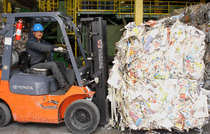
Its the length of the fiber that determines how many times it can go through the recycling process, which is why we dont like shredded paper. Heres how it works: Recycled paper is poured into a vat of liquid where it gets mixed into a slurry before its remanufactured. As the new paper gets recycled again and again, the fibers get shorter and shorter each time they go through the process. Shorter fibers are only useful for lower grades of paper. For example, once high grade office paper or junk mail has enjoyed a few lives as letterhead or stationery, it will be demoted and used for shorter fiber applications such as paper toweling. Paper fibers will eventually get too short to be rewoven into new paper and they get washed out in the process.
So the next time you purchase your recycled office paper (as all good recyclers do), you might try hypnotizing it for a past-life regression. You never know, it might suddenly blurt out, "YOU may already be a winner!"
For more answers to your recycling and
environmental questions, see our Ask Eco-Cycle column in
the Daily Camera printed every other Friday in
the Portraits section.
Send your recycling questions to:
Ask Rosie
c/o Eco-Cycle
P.O. Box 19006
Boulder, CO 80308.
Or: e-mail Rosie at recycle@ecocycle.org.