













|
You dutifully separate your recyclables,
then put them out at the curb or bring them to the Drop-off
Center, but what then becomes of your beloved bottles and precious
paper? The majority of recyclables collected in Boulder County go
to the Boulder County Recycling Center where EcoCycle crews
prepare them for market.
Anchors Awaaaay!
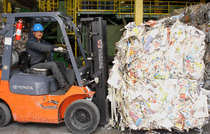
Recyclable materials start their journey through the facility in
the tipping hall. Papers are sent up a conveyor belt where the
corrugated cardboard pieces are sorted out by a series of rotating
drums that keep the larger cardboard pieces on top while the
smaller paper materials (office paper, for example) fall through
onto a conveyor belt for further manual sorting.
In The Thick of Things
Commingled Containers travel up a conveyor belt from the tipping
hall to be sorted by machines and people. First, a big magnet
pulls off the steel cans and shunts them into a holding cage.
Then, the remaining glass, aluminum and plastic travel over a
shaker that sifts out the small glass fragments. Two fans then
simultaneously lift and blow the light materials (aluminum cans,
foil, and plastic) onto a manual sort conveyor belt. The heavier
glass falls down to yet another conveyor and is sorted by hand
into green, clear, and amber varieties. Once the plastics have
been sorted out from the aluminum by hand, an eddy current
separator repels the aluminum into a blower that sends it to its
own holding cage. The remaining materials are small bits of
garbage—plastic lids, bits of labels, foreign objects—which must
exit the facility as trash. All the sorted materials except glass
are then baled and shipped to markets both within and outside of
Colorado.
Paper Parade
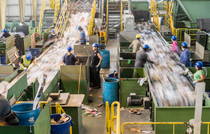
Paper is sorted manually along a conveyor belt. In the photo to
the left, workers are pulling paperboard out from the mixed paper
that has come in from the Boulder curbside program. Because all
the paperboard must be removed, Boulder residents are required to
bring smaller paperboard items directly to the Drop-off Center;
small paperboard items are difficult to pull out of the mix and
may be missed in the sorting procedure.
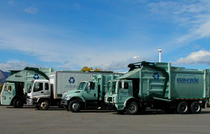
Once materials are cleaned and sorted, they are sent off to market
to begin their new lives as recycled products. Some materials are
shipped by rail—a new opportunity for cost-effective shipping made
possible by the rail spur at the new facility—while some materials
are still hauled by truck.
Where does it go and what does it become?
Newspaper: Sent to mills in Arizona and in Portland,
Oregon, where it is recycled into new newsprint. The Arizona mill
is a 100% post-consumer recycled fiber mill--meaning that the
feedstock for the new newsprint comes entirely from old newspaper
collection programs like Eco-Cycle¹s. Some Colorado newspapers buy
paper from this mill, thus ³closing the loop.²
Magazines and Catalogs: Shipped to a mill in Washington
State, where the fibers are recovered for use in a variety of
papers. Magazines and catalogs are sometimes mixed with newspaper
during the pulping process. The clay coating on magazine paper is
effective in helping de-ink the newsprint!
Office Paper, White Ledger, and Milk/Juice Cartons:
Marketed to a variety of mills in other states. The fibers from
these papers are reprocessed into office paper, letterhead
stationery, envelopes and some lower-quality paper products such
as tissues. Milk and juice cartons contain strong paper fibers but
require a special recycling process to separate out the various
plastic and wax coatings on the containers.
Corrugated Cardboard and Brown Paper Bags: Shipped to New
Mexico. The paper fibers are processed and formed into new
corrugated cardboard products such as shoeboxes.
Glass Bottles and Jars: Both amber (brown) and mixed
colored glass are sent to Coors in Golden. The glass is recycled
into new beer bottles.
Steel Cans: Sent to the Pueblo Steel Mill in Pueblo. At
this plant, the tin is separated from the other metals and sold in
ingots to the canning and electronics industries. The remaining
steel is melted and used to produce car parts, metal hardware, and
baling wire--the stuff we use to strap our paper bales!
Scrap Metal: Trucked to Newell Recycling in Denver. Newell
shreds the metal, removes contaminants, separates out the ferrous
(iron-containing) component and the more valuable metals, and
prepares the various materials for shipment as feedstock to a
number of steel ³mini-mills² that then produce new steel products.
Paperboard: Typically marketed in Mexico and then recycled
into a variety of low-grade paper products such as egg cartons,
wall insulation, tubes for tissue products and other items.
Plastic Bottles and Tubs: Marketed through plastics brokers
in California, and from there shipped to Chicago or to countries
in SE Asia. The plastic fibers are used in carpet, clothing, paint
containers (buckets), auto parts, tennis balls, shower curtains,
detergent and engine-oil bottles, parking stops, park benches, and
a range of other stuff.
Phone Books: Sent to Qwest, who sends them on to a paper
mill that makes paper for new phone directories. Phone books
contain paper that is of VERY low quality as far as fiber strength
goes--maybe that¹s why some folks can rip them in half!
Car Batteries: These lead-acid power units are shipped to
All Recycling in Denver. 98% of the batteries¹ contents are
recovered and used to make new batteries.
Pallets: The wooden pallets EcoCycle uses in processing
activities are sent to Wood Recovery Systems in Longmont when
they¹re no longer functional. There they are chipped and ground
into decorative mulch.

|