



















Front Page

Director's Corner

Volunteer Opportunities

Environmental Choices

Enviro-Calendar

Ask Rosie

Become an Eco-Cycle Member

In This Issue

Landfills Cause Global Warming

What Happens to my Recyclables?

Girl Scouts Go for Zero Waste

Read the Label First: Avoid Toxins Before You Buy

Partners for a Clean Environment


Computer Recycling the Green Way

New Materials Accepted at the CHaRM

Glass Recycling Becomes a Challenge

How's the Air Quality in Your Home?

Zero Waste Around the World

Recyclers Get 10% from Coke and Pepsi

Local Action for Global Warming


EcoExtras: Thank You's

CU Update

Warming Up to Compost


Computer Recycling the "Green Way"
EcoCycle-Boulder Center Does NOT Market Electronics to Third World

You may have recently read in your local paper about American companies dumping toxic “ e-waste” (electronic trash) overseas, creating significant environmental and health hazards in the developing world. The articles refer to a new report, “Exporting Harm: The High-Tech Trashing of Asia” from the Silicon Valley Toxics Coalition and the Basel Action Network, that revealed extremely hazardous and dangerous e-waste operations in Asia that pollute the air, water, and soil where the materials are processed. According to the report, 50 to 80 percent of electronics waste collected for recycling in the U.S. is sent to China, India, Pakistan or other developing countries where it is processed for recycling in largely unregulated and environmentally horrific conditions.

The news is shocking and disturbing, but it is not new information to us at EcoCycle. We have long been aware that many electronics “recycling” programs create environmental havoc when the collected materials are sold to the higher-paying Asian markets that use cheap labor to disassemble whole units, exposing employees and the environment to the major toxins inside. It is a deeply unfortunate situation for the people of these countries where free trade in hazardous waste leaves them with the impossible choice of poverty vs. poison.

CHaRM Goes Green
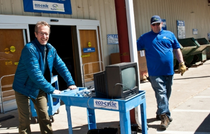
That’s why, when you bring your computer, TV, VCR, copier, fax machine, or cell phone to our new Center for Hard-to-Recycle Materials (CHaRM), you can know that this community program is among the 20 to 50 percent of electronics recyclers who do not market to vendors who ship whole computer units to developing countries.

When we planned to collect and recycle old computers and TV’s, we went searching for the “environmental alternative”—an environmentally-superior solution instead of a quick buck. It wasn’t easy since most programs focused on the bottom line. So, we got a grant from the Environmental Protection Agency and proceeded to define the spectrum of options that recyclers have—from “pure green to pure greed.” We then created and documented the clean approach for e-waste recycling. Our report on marketing green will be used as a guide to help other Colorado e-waste recyclers market to environmentally-responsible vendors.

EcoCycle knows that you, our local supporters, expect us to adhere to the highest possible environmental ethics. For that reason, the agreements we have with all our vendors clearly state that they cannot send whole units overseas (and we can audit them to make sure), that they must demanufacture the equipment domestically, and that Cathode Ray Tubes (CRTs, the most toxic part of the computer) must be recycled domestically in their entirety and must be recycled back into CRTs (the highest use for this material). Vendors also must recycle 98% of the computer (highest known level). If we discover that any vendor is in violation of this agreement, we will discontinue marketing to them.

Holding Producers Responsible
But we’re not satisfied with just creating good recycling solutions, we’re also going “upstream” to the source of this waste problem—the electronics industry. EcoCycle is one of the leading national voices supporting a new European concept called “Extended Producer Responsibility (EPR).” EPR says simply that a producer (i.e., manufacturer or importer) is responsible in a legal and financial way for the end-of-life management of their products and packaging. If this were to become one of the rules by which business must play, they would be making many more products and packaging that are recyclable, compostable or re-usable. We could then say goodbye to the expensive Superfund landfills, like our very own Marshall (Boulder) Landfill.

At the local level, we advocate that all the manufacturers of electronic products help pay the cost of recycling their products in an environmentally-responsible way. (As it is today, EcoCycle, the City of Boulder taxpayers, and visitors to the CHaRM are paying for that service by funding the CHaRM.) If the idea of EPR sounds radical to you, it’s not. Twenty-eight nations have some form of EPR or industrial “take back” laws that require businesses to fund end-of-life product management programs. The U.S. isn’t one of them, but that doesn’t mean that Boulder can’t step in front of the pack (again) and show the way forward.

So, when you come to the new EcoCycle-Boulder Center for Hard-to-Recycle Materials (CHaRM) and shell out your $10 to recycle your computer monitor, you are supporting the “green” approach to recycling. We know our community would want nothing less.


Many States Take Legislative Action to Prevent Toxic e-Waste from Being Landfilled or Incinerated

Legislation Passed
Massachusetts: Passed legislation to make it illegal to dump the most egregious culprit – cathode ray tubes (CRT’s) typically used in televisions and computers. These contain four to eight pounds of lead and a host of other toxic elements that can contaminate the environment when landfilled or incinerated.

California: Passed a law prohibiting televisions and computer monitors from being landfilled.

State Legislation Under Consideration
California: Law would require manufacturers to label some electronics as hazardous and require those producers to set up a recycling program or pay a fee to the state to do so. Another bill would require advance disposal fees charged on any CRT sold; the revenues would be used to fund a recycling program.

Oklahoma, Maryland, Hawaii, Pennsylvania: Law would ban CRT’s from landfills.

Maine: Law would require retailers to take back old electronics if consumers have their original sales receipts.

Massachusetts: Law would require manufacturers that sell CRT’s to have a plan for “convenient and accessible collection” so that consumers can recycle them.

New York: Law would establish “Extended Product Responsibility” for electronics containing hazardous material and require collection centers to recycle them.

Oregon: Law would require consumers to pay into a Personal Computer Recycling Account when purchasing computers. The money would be partially refunded when purchasers recycle their computers.

South Carolina: Law would establish a $5 fee for items containing CRT’s. The money would go towards a recycling program.

Colorado: While no similar legislation is currently proposed for Colorado, EcoCycle would like to see “producer responsibility” laws passed that require companies to pay for recycling programs instead of placing the burden on local government, non-profits or consumers. EcoCycle would also like to form voluntary partnerships with manufacturers to support recycling programs like the EcoCycle-Boulder Center for Hard-to-Recycle Materials.


Home | Recycle at Home | Recycle at Work | Recycle at School | Hard-to-Recycle Center - CHaRM | Tidbits and Facts |
Zero Waste | Newsletter | Calendar and Info | Composting | Buy Recycled | Hazardous Waste | Stop Junk Mail | Volunteer |
Support Eco-Cycle | Site Map |


Newsletter Web Site Design By Ariel Design Group
© Copyright Eco-Cycle, 2000.
All rights reserved.