






|
Thank
you, Boulder County, for our first 25 years as your community-based
recycler. In the next two issues of the EcoCycle Times well
be featuring some great moments in EcoCycle history, shared
by some of our founding volunteers, employees, and EcoCycle
grandmothers. There are far too many stories
to print, but heres a taste of our rugged beginnings
and how a group of committed volunteers gave birth to recycling
in Boulder County one of the first communities to
implement recycling in the United States. Many thanks to
the pioneers who started this recycling revolution and to
those who continue to carry on the legacy. We are honored
to serve such a dedicated community.
1976:
EcoCycle is Born
Local activists Roy Young and Pete Grogan were concerned
with the amount of resources needlessly going to waste in
a landfill. They launched EcoCycle as a non-profit to create
an opportunity for Boulderites to preserve resources. The
first collections are done with barrels put out on a Saturday
at various locations around Boulder very humble beginnings
for what is now the largest non-profit recycler in the country.
June
Sampson, an EcoCycle Grandmother:
I was reading the newspaper one day, and there was a three
line news story about these two guys who wanted to start
a recycling program. That excited me so I called them and
invited them over for a drink milk
and
cookies that is. I immediately liked them both immensely.
I told them to get a group together to help advise them.
They didnt know many people, but I did. We got a banker,
a lawyer and a bookkeeper to help us. Mind you this was
way before people knew what recycling was. It wasnt
even a widely used word yet. But people were ready and eager.
Recycling?
Whats that?
In 1976 recycling was considered a radical concept, if people
knew about it at all. Boulder was one of the first 20 cities
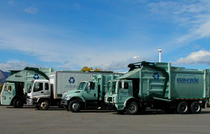
in the nation to have curbside collections. EcoCycle school
buses loaded with volunteers and community groups rumbled
down the street to pick up the material. Today there are
over 7,500 curbside programs in the US, more people recycle
than vote, and recycling is a household word.
Will
Toor
Now: City of Boulder Mayor
Then: EcoCycle Worker in the Trenches
EcoCycle was the first place I worked when I came to Boulder.
At first I worked on Saturdays riding around in the back
of an old school bus helping pick up recyclables. Then I
began working full time in the yard. We had an unusual assortment
of characters working together. There was a professor of
Chinese history, a physicist, numerous college students
all there doing manual labor because EcoCycle was
a great experiment in environmental development.
1979:
Grand Opening of Our New Facility at 5030 Pearl
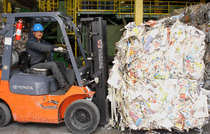
EcoCycle actually got a facility with a baler donated by
Coors to allow us to ship market-ready materials and thus
survive when so many other non-profits were folding. Tim
Wirth (now Executive Director of the United Nations Foundation)
and Gary Hart were featured speakers. The volumes processed
in the first year were 2,730 tons. Volumes processed at
the same facility last year were approximately 40,000 tons.
Fittingly, in our 25th anniversary year, EcoCycle processing
will be moving into a modern, indoor facility.
Volunteers
Essential to Success
An army of volunteers banded together to help promote the
concept of recycling on their own blocks they became
the Block Leader Network. The program has been duplicated
all around the country. Today, EcoCycle has over 800 Block
Leaders county-wide.
Kay Shapley, an EcoCycle Grandmother:
There was talk about getting neighbors to recycle but the
question was how to do it. I organized the first Block Leader
Network in Frasier Meadows by distributing notices to all
the homes asking for volunteers on each block. Soon we had
people in every neighborhood distributing the EcoCycle Times
and putting up signs the day the school buses came around
for the recyclables. From then on the Block Leader idea
caught on very quickly in other neighborhoods.
EcoCycle
Goes to School
Recognizing that the best way to instill new habits in a
community is through the kids, Eco-Cycle works with Boulder
County, Boulder Valley, and St. Vrain Valley School Districts
to educate a new generation of recyclers by creating the
Schools Program. The program has won the highest national
awards in both recycling and environmental education fields.
The
Key to a Successful Recycling Business Isnt in the
Facility
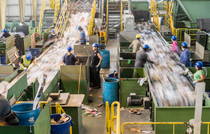
EcoCycle is now the largest, non-profit recycler
in the nation, processing approximately 40,000 tons of recyclables
per year. For 25 years, all processing has been done outdoors
with sorting equipment primarily designed and built by EcoCycle.
In fact, EcoCycle staff designed and built Colorados
first commingled container sorting system that allows recyclers
the convenience of mixing their containers together and
allowing for the collection of more materials from the curb.
Id like to thank EcoCycle very much
for providing our visitors from the Philippines with a tour
of EcoCycle last week. We learned that a business plan that
focuses on high volumes, good quality, and fast turn-around
is what it takes to run a successful recycling business,
not necessarily a five or ten-million dollar MRF [Material
Recovery Center]. It was great to see first hand what an
active and market-oriented business you are directing. EcoCycle
deserves a lot of credit for making its recycling facility
such a going concern.
Gregory Byrne, Director, April 5, 2001
Community Planning and Environmental Services, City of
Fort Collins
|