









Front Page

Director's Corner

Volunteer Opportunities

Environmental Choices

Enviro-Calendar

Ask Rosie

Become an Eco-Cycle Member

In This Issue

EcoCycle's First 25 Years

EcoCycle's Next Step: A One-Stop Drop

Boulder's Drop-off Center to Move

Changes for Boulder Recyclers

New Boulder County Recycling Center is Ready

Computer and Electronic Recycling: EcoCycle's New Frontier

Boulder County Dumps on Neigbors

Zero Waste Around the World–Why Not Here?

CU Recycling Update

U.S. Corporations More Environmental in Other Countries

Some U.S. Companies Implementing Zero Waste

Composting Made Simple

New Boulder County Recycling Center is Ready

EcoExtras

Boulder County Dumps on Neighbors
by Brian Ladd

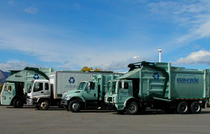
Each day a parade of trucks hauls more than 4,000 cubic yards of waste—enough to fill a football field almost 3 feet deep—to be buried in other counties landfills


An Un-neighborly Practice
Chances are you wouldn’t pick up your trash can each week and dump it into your neighbor’s yard—but that’s exactly what we as Boulder County residents do to our neighbors in Weld and Jefferson Counties. Since 1992 we have shipped them both our waste and its associated long-term environmental and public health problems.

Each day, a parade of trucks hauls more than 4,000 cubic yards* of food waste, construction debris, electronics containing hazardous materials, and other waste across county lines to bury it in our neighbors’ “back yard.” That’s a football field almost three feet deep in garbage every day!
Why do this un-neighborly thing in the first place? Because the misleading market signals of price and cost perpetuate the falsehood that there are inexpensive “sanitary” landfills nearby for Boulder County to use. The problem is, no landfill is sanitary or cheap.

Can a Landfill be “Sanitary?”
Landfills today are constructed under the Environmental Protection Agency’s (EPA) 1991 Subtitle D regulations. Subtitle D regulations define the technology that must be used to prevent waste materials from migrating out of landfills—e.g., clay barriers, plastic liners, and methane collection systems. These technologies often work well for a while, when the landfill is young.

However, even the EPA admits that it is a question of “when” and not “if” landfill protective barriers will fail: “Even the best liner and leachate collection system will ultimately fail due to natural deterioration, and recent improvements…suggest that releases may be delayed by many decades at some landfills.”1 Furthermore, says the EPA, “Once the unit is closed, the bottom layer of the landfill will deteriorate over time and consequently will not prevent leachate transport out of the unit.”2

This last point is especially important, because Subtitle D regulations only require landfill operators to deal with leachate (garbage “juice”) and gas emissions for 30 years after landfill closure. But based on the EPA’s assessment and real-life experience, leachate from landfills continues to threaten the environment long after 30 years have passed. Some European countries recognize this and require monitoring and treatment for 300 years post-closure! Yet here in the US, the long-term responsibility for this toxic mess is left to you, me, and our children’s children.

Is A Landfill Cheap?
Prior to 1992, trash from Boulder County was buried in the Marshall landfill, just southeast of the city of Boulder. While waste was still being dumped there, the combination of wet wastes already in the landfill and rainwater filtering down created toxic leachate. Because the Marshall landfill was not engineered to contain this ooze, it entered the groundwater. Now, each year the city of Boulder pays $400,000 (BFI/Allied Waste, the landfill operator, also pays $400,000/year) to fund ongoing monitoring and clean-up efforts needed to protect the environment from further contamination. The EPA has also declared the facility a Superfund site, meaning some of our federal as well as local tax dollars are involved in mitigating this threat to the groundwater in southeast Boulder County. This could easily continue for decades—with no end in sight. “Cheap” landfills—like Marshall must have seemed during its heyday—are only cheap on the front end, and only for the short term. The real-life, long-term costs are very large and very persistent.

A New Vision
What’s the answer when our own defunct landfill is oozing toxic leachate and we can’t in good conscience dump trash on our neighbors? Boulder County needs to adopt a comprehensive Zero Waste plan that would significantly decrease our dependence on landfill technology and replace it with a mix of infrastructure and policy including:

1) A recovery center (or centers) for a wide variety of hard-to-recycle materials such as electronic equipment

2) Accessible community-based composting operations

3) Adequate recycling facilities and collection mechanisms for all recyclable materials

4) Local legislation to increase producer responsibility for waste and require recycling/recovery of products and packaging, as well as phase-outs of non-recyclable and hazardous materials used in manufacture

5) Container deposit and take-back laws

6) Elimination of the subsidies, policies, and incomplete accounting that make wasting the “cheapest” alternative for discards.

It’s time we begin sharing the best of Boulder County—things like Zero Waste policies and exemplary Zero Waste practices—with our neighbors next door, not a legacy of waste and environmental problems!

*This is a conservative estimate, since it does not include Boulder County trash transported to the Foothills Landfill in Jefferson County. Trash volume data from this landfill were not available.

1 U.S. Environmental Protection Agency Federal Register, August 30, 1998, Vol. 53 #168.
2 Ibid
.


Home | Recycle at Home | Recycle at Work | Recycle at School | Hard-to-Recycle Center - CHaRM | Tidbits and Facts |
Zero Waste | Newsletter | Calendar and Info | Composting | Buy Recycled | Hazardous Waste | Stop Junk Mail | Volunteer |
Support Eco-Cycle | Site Map |


Newsletter Web Site Design By Ariel Design Group
© Copyright Eco-Cycle, 2000.
All rights reserved.