




















Recycling has become a national habit, a daily ritual practiced by over 100
million people every day. Yet recycling alone will not end our dependency on
landfills and incinerators, nor reverse the rapid depletion of our natural
resources. As world population and consumption continue to rise, it is clear
that our one-way system of extracting virgin resources to make packaging and
products that will later be buried or burned is not sustainable.
Zero Waste is a new way of looking at our waste stream. Instead of seeing
used materials as garbage in need of disposal, discards are seen as valuable
resources. A pile of "trash" represents jobs, financial opportunity,
and raw material for new products.
Other countries around the world and some U.S. communities have begun to
evaluate and redesign their current systems to encourage resource recovery and
to create a more materials-efficient economy. American companies who do business
overseas are already redesigning their products and manufacturing processes to
meet the Zero Waste standards adopted by other countries. If they can do it
there, they can do it here.
What is Zero Waste?
Redesigning Products and Packaging for Durability, Reuse and Recyclability
Instead of perpetuating our throw-away society, products would be designed
using fewer material types that could be easily reused or repaired when they
have outlived their usefulness.
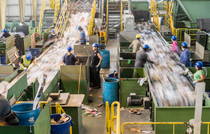
Creating Jobs from Discards
Wasting materials in a landfill also wastes jobs that could be created if
those resources were preserved. According to the new, ground-breaking report,
Wasting and Recycling in the United States 2000, "On a per-ton basis,
sorting and processing recyclables alone sustains ten times more jobs than
landfilling or incineration."1 According to the report, some
recycling-based paper mills and recycled plastic product manufacturers employ 60
times more workers on a per-ton basis than do landfills. The report adds,
"Each recycling step a community takes locally means more jobs, more
business expenditures on supplies and services, and more money circulating in
the local economy through spending and tax payments."2
Producer Responsibility
Zero Waste puts the responsibility for materials entering the waste stream on
the front-end with the manufacturer, not on the consumer at the back-end of the
product’s life. The end result is that manufacturers redesign products to
reduce material consumption and facilitate reuse, recycling and recovery.
"True Cost" Accounting
The price of a product does not currently reflect the full costs of the
environmental degradation and public health impacts associated with the virgin
resource extraction, processing, manufacture, transportation, and disposal of
that product. When the market prices begin to include such costs, the more
environmentally-friendly product will also be the less expensive.
Investing in Infrastructure, Not Landfills
In many communities, strategies like unit-based pricing for garbage
collection (commonly known as Pay-As-You-Throw) have created tremendous
incentives for residents and businesses to reduce waste and have resulted in
higher landfill diversion rates. Rather than using the tax base to build new
landfills or incinerators, communities have also invested in recycling,
composting, and reuse facilities. In some cases, communities have created
integrated discard "malls" where various recycling and reuse
businesses coexist in a location where consumers can come to drop-off any
unwanted item.
Ending Tax Payer Subsidies for Wasteful and Polluting Industries
Pollution, energy consumption and environmental destruction start at the
point of virgin resource extraction and processing. Our tax dollars subsidize
many industries that make products from virgin materials, such as timber and
mining. Zero Waste proposes ending these federal subsidies to enable recycled
and reused products to compete on an even playing field. Without the subsidies,
the market can determine which are truly the less expensive products.
1. Brenda A. Platt and David Morris, The Economic Benefits of Recycling
(Washington, DC: Institute for Local Self-Reliance, February 1993), p. 9.
2. Michael Lewis, Recycling Economic Development through Scrap-Based
Manufacturing (Washington, DC: Institute for Local Self-Reliance, February,
1994).