





















This year, as you mailed in your tax dollars to Uncle Sam, it’s doubtful
you hoped some of that money would be earmarked to help cut down our National
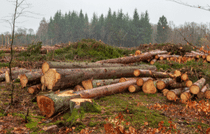
Forests. Yet every year Congress uses your hard-earned tax dollars to do just
that. The federal timber sale program, which subsidizes private timber
corporations to log nearly 500,000 acres of our National Forests, operates at a
net loss to U.S. taxpayers of approximately $1.3 billion each year.1
The effects of this corporate welfare program go far beyond the loss of
trees. Forests regulate the climate and produce clean air and water. Logging
destroys water quality by causing soil erosion and river siltation — often
resulting in landslides and flooding — and contributes to the destruction of
fisheries and the loss of wildlife habitat. Cutting trees on these public lands
also diminishes the recreational, tourism and other economic opportunities
available from the National Forest system.
The subsidies were created over 100 years ago to spur the development of the
West and to encourage the transition from an agrarian to an industrialized
society. The program was successful in that many jobs were created and millions
of people moved west. Today, however, resource conservation, not exploitation,
is the primary public concern.
Despite the fact that more than 120 million Americans recycle (more than
currently vote!), federal subsidies to the timber industry discourage recycling
and undermine local recycling programs. The subsidies make pulp from trees
artificially less expensive than recycled pulp, putting recycled paper
manufacturers at a competitive disadvantage.
In 1997, Congress members Jim Leach (R-IA) and Cynthia McKinney (D-GA)
introduced the "National Forest Protection and Restoration Act,"
legislation that would end this fiscally wasteful and environmentally
destructive government spending program. The bill currently has 76 cosponsors.
- The National Forest Protection and Restoration Act (House of
Representatives Bill 1396) would:
- Protect and restore America’s natural heritage by ending the
commercial logging program
- Assist communities dependent on the federal logging program with economic
recovery and diversification by providing worker retraining for displaced
timber workers and creating jobs through a scientifically-based forest
restoration program
- Fund development of non-wood alternatives for pulp and paper
- Save taxpayers over $300 million annually
As part of its national campaign to end federal subsidies that undermine
recycling, the GrassRoots Recycling Network (GRRN) has joined the national drive
to pass H.R. 1396.
Here in Colorado, Eco-Cycle and the Colorado chapter of GRRN are working with
the National Forest Protection Campaign to build public support for this
important legislation. Given that our state is home to many National Forests, we
are expecting leadership from our six-member House delegation to protect our
public lands.
Clearly, the American people should not be expected to subsidize fiscally
irresponsible and environmentally destructive enterprises — especially on our
public lands. It’s time for our elected officials to join the 69%-75% of
Americans who oppose logging our National Forests.
To join the National Forest Protection Campaign here in Colorado, please
contact Tom Weis at twgreenfire@earthlink.net or call (303) 245-8178.
1. From the U.S. General Accounting Office and the U.S. Forest Service Timber
Sale Program Annual Report, Fiscal Year 1997.