















Front Page

Director's Corner

Volunteer Opportunities

Environmental Choices

Ask Rosie

Become an EcoCycle Member

In This Issue

CHaRM Now Accepting Plastic Bags

Cell Phone: New Toxic Burden

Recycling in Superior

In Memory of Rudd

Celebrating Year One at the CHaRM

Proposed Ban on Mercery Thermometers

New Drop-Off Site for Clean Wood Waste

POPs Pose Health Threats

Toxicity of Plastic Food Wrap

Zero Waste Around the World

CU Recycling Update

Proposed National Bottle Bill

Dogging Dell to Take it Back

Big Business Withholding Environmental Costs

Waste-Free Holidays

Thank  You's

Dear Rosie,

Is it permissible to put shredded paper in with office paper at the curb or at my workplace?

Signed,
Carl B

Dear Carl B,

Sounds like a simple question, doesn’t it? Here’s the simple answer: No, please don’t put shredded material in with office paper at the curb or at your workplace. The only place to recycle shred is at the Drop-Off Center and you should put it into the Paperboard box. Now here’s the not-so-simple explanation: What most folks don’t know is that in the recycling world there are few things less popular with our paper buyers than what we call “shred.” Shred is about as well loved by recycling markets as mosquitoes on a camping trip, or hamburger casserole at a vegetarian potluck, or bathing suits on a nude beach…I think you see what I’m saying.

There are several reasons for shred’s low popularity ratings.  First, the environmental reason (of course the primary concern): when you cut paper with scissors, or a whole bunch of scissors (like a shredder), what you’re actually doing is cutting the individual paper fibers in half, thus cutting future recycling potential of that fiber in half. The length of a paper fiber determines its value since a longer fiber can be used to make a higher-grade paper and can be recycled over and over.

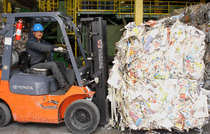
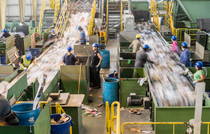
Now for the operational reason. At the new recycling facility, mixed paper from households and businesses goes over a great new automated “screen” that makes the paper product cleaner than ever by shaking out non-fiber contaminants like bits of glass, etc. The only problem is that the shred gets “grabbed” by the fingers on the screens and gets pulled into the reject bin, and off to the landfill.

Finally, there’s the market reason. The paper mills that buy recycled paper must do a quality sort on the material before they put it into their multi-million dollar machines, and it’s just plain impossible to do a good quality sort of shredded paper.  Many contaminants can “hide” in the shred, primarily plastic strips from a document cover that were accidentally shredded along with the paper.  So, along with the fact that fibers that have been shortened by shredding are of less value, they are also a quality problem, thus paper markets don’t like to buy them and certainly don’t like to see them in with the higher-grade junk mail and office paper materials.

So the answer is that you should save your shredding activities for cheese and carrots. But if you must shred paper, please put the setting on the thickest width so that your confidential information is illegible, but there is more intact fiber. If you do have shredded paper materials, please take them to the drop-off center and recycle them with paperboard (cereal boxes, shoe boxes, etc.). Paperboard is a much lower-grade category that is more appropriate for shred, and we don’t run it over the screens at the recycling facility, we just dump-n-bale and then we pay the markets to take it for recycling!


Dear Rosie,

 Is there any place that takes cell phones and reuses, rebuilds, or recycles them? If they don’t work, should we throw them away?

Signed,
Jennifer in Boulder

Dear Jennifer in Boulder,

Recycled-content lumber is easy on the environment, maintenance-free, easy to work with, long-lasting, affordable and saves natural resources. Recycled-content lumber is an alternative to wood that can contain100% post-consumer plastic or a composite of recycled plastic and recycled wood waste. (In fact, the plastic bags Eco-Cycle collects will be made into this product.) It is rapidly gaining popularity in the construction of structures such as playground equipment, pallets, park benches, picnic tables, fencing, decks, and docks. Using plastic or composite lumber conserves trees and keeps milk jugs and plastic bags out of landfills and incinerators.  The material does not leach harmful chemicals into water and soil like pressure treated lumber and its associated cleansers, stains and sealants. Though initially more expensive than wood, savings come in avoided maintenance and replacement costs. Recycled-content lumber is available at any lumber yard near you


Send your recycling questions to:
Ask Rosie
c/o Eco-Cycle
P.O. Box 19006
Boulder, CO 80308.

Or: e-mail Rosie at recycle@ecocycle.org. If we print your letter, we'll send you an Eco-Cycle mug.


Home | Recycle at Home | Recycle at Work | Recycle at School | Hard-to-Recycle Center - CHaRM | Tidbits and Facts |
Zero Waste | Newsletter | Calendar and Info | Composting | Buy Recycled | Hazardous Waste | Stop Junk Mail | Volunteer |
Support Eco-Cycle | Site Map |


Newsletter Web Site Design By Ariel Design Group
© Copyright Eco-Cycle, 2000.
All rights reserved.