









Front Page

Director's Corner

Volunteer Opportunities

Environmental Choices

Enviro-Calendar

Ask Rosie

Become an EcoCycle Member

In This Issue

New EcoCycle-Boulder Center for Hard-to-Recycle Materials

New Boulder Ordinance Creates Incentive to Reduce Waste

New Guide to Hard-to-Recycle Materials

Partners for a Clean Environment

New Boulder Drop-off Center is Open

Boulder County Recycling Center Grand Opening

Tribute to Mary Sucke

Zero Waste Around the World

Expanding Recycling Opportunities for County Drop-off Centers

Broomfield Recycling Center Turns Three

Mercury: Ancient Metal, Modern Threat

National Energy Act Encourages Wasting

Producer Responsibility Essential to Recycling Electronics


CU Recycling Update


Holiday Tree Recycling

Thank You's!
Dear Rosie,

Why is it that frozen food boxes aren’t recyclable with paperboard at the Drop-off Center? Those boxes look exactly the same as cereal boxes.


Signed,
Confused

Dear Confused,
Your mother probably said it a hundred times: "looks can be deceiving." Little did you know you’d be applying this age-old wisdom to recycling paperboard. Frozen food boxes may look the same, they may smell the same, they may even taste the same (I wouldn’t know), but there is one key difference: the fiber in frozen food containers has been sprayed with a plastic polymer that works as an oxygen barrier to keep food from spoiling. That can be good for your frozen cheese enchiladas, but it’s a bad thing for recycling. Paperboard is recycled by mixing it with water in a giant blender to create a pulp. But fiber sprayed with a plastic polymer won’t pulp up, and instead it becomes a contaminant that needs to be fished out and thrown away. So please add this to your list of wise sayings: "if the box goes in your freezer, it doesn’t go in your paperboard." Okay, so it’s not very eloquent, but it’s a good rule to follow, nonetheless.


Dear Rosie,
I see that EcoCycle is collecting "Commingled Containers" at all the Drop-off Centers and in all the curbside programs. Doesn’t mixing all these containers together make it a lot harder for you to recycle them, since you’ll have to separate them before they go to market? Wasn’t it better for EcoCycle when the public did the separating?

Signed,
Dorothy

Dorothy,

Well, yes, in a way it was easier for materials to come in completely "source separated"-as we say in the biz. Less sorting on our part does mean lower processing costs. However, there are disadvantages to a fully separated system that stand in the way of recycling’s progress. For one, you can’t collect as many materials from the curb or from Drop-off Centers if you have to keep them separated. In order to collect from the curb all the items included in "commingled containers" you’d have to have four or five different sections in the truck-and that would be in addition to all the sections you’d have to have for paper! Different sections fill up at different rates, multiple dividers waste a lot of space, and you’d need one mighty long truck to have enough sections.

What’s more, one of the hindrances to getting people to recycle is the inconvenience of separating materials at home and finding storage space for a bazillion different categories of recyclables. Convenience is the key to getting 100% recycling participation, so the future of waste diversion includes more commingling, not less. Picture a world where all you do is sort your discards into "wet" and "dry" (compostables and recyclables). That’s where we’re going next! Of course, recyclers can still help us out by making sure they include only the materials listed in the commingled container guidelines, and by carefully following those guidelines.


Dear Rosie,
I went to the Drop-off Center in my town where EcoCycle is now collecting "Commingled Containers" and all the containers get mixed together in one bin. The sign on the box said, "Please avoid breaking glass." Why is that, and what if I’m the first to recycle in an empty bin? The glass is very likely to break. The glass box didn’t used to have a sign like this on it.

Signed,
Shattered in Lyons

Shattered in Lyons,

You’re right. Used to be, when glass was separated by color, breaking it was not a problem. In fact, it used to be a popular anger-release activity to fling those bottles into the bin and hear them smash to bits.

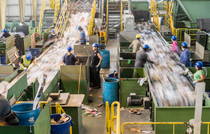
Unfortunately for the angry or destructive among us, breaking glass is now a bad thing for recycling. Here’s why: At the new Boulder County Recycling Center, containers are brought in mixed together and then separated and prepared for market. They initially go through an automatic sort system where lighter items like plastic and aluminum are separated from the heavier glass items. Glass must then be sorted by hand and separated into the different colors. As you can imagine, little shards of glass are not easily sorted so the glass goes over a screen to sift out dirt, pebbles and little glass pieces that are too small to sort. These little pieces become unrecyclable. Of course, breakage happens (that’ll be the next bumper sticker), but the best way to help avoid breakage is to take that anger we used to release by breaking glass, and turn it on a plastic gallon milk jug or liter pop bottle. STOMP on those plastic bottles, and they become a cushion for the glass! (Fully inflated bottles just balloon to the top of a pile.) That way we can have our unbroken glass and our anger management, too. Isn’t that beautiful?


Send your recycling questions to:
Ask Rosie
c/o Eco-Cycle
P.O. Box 19006
Boulder, CO 80308.

Or: e-mail Rosie at recycle@ecocycle.org. If we print your letter, we'll send you an Eco-Cycle mug.


Home | Recycle at Home | Recycle at Work | Recycle at School | Hard-to-Recycle Center - CHaRM | Tidbits and Facts |
Zero Waste | Newsletter | Calendar and Info | Composting | Buy Recycled | Hazardous Waste | Stop Junk Mail | Volunteer |
Support Eco-Cycle | Site Map |


Newsletter Web Site Design By Ariel Design Group
© Copyright Eco-Cycle, 2000.
All rights reserved.